
常见材料的吸声系数
建筑和声学材料在标准频率下的吸声系数(α)。
概述
吸声系数描述材料吸收而非反射的入射声能比例。数值范围从 0(全反射)到 1(全吸收),并随频率变化。工程师使用这些系数来预测混响时间、选择声学处理方案,并设计围护结构、隔断和礼堂。
降噪系数 (NRC) 是单数值评级,等于 250、500、1000 和 2000 Hz 下吸声系数的算术平均值,四舍五入到最接近的 0.05。
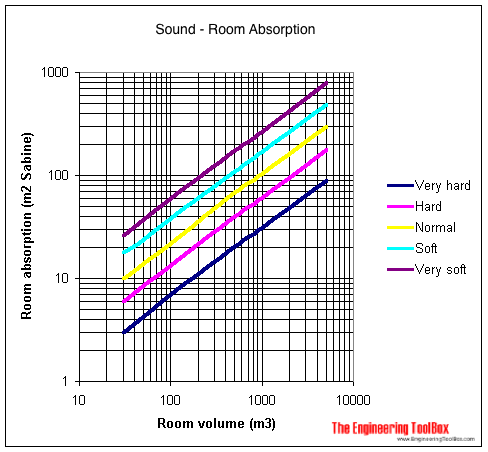
保留原始来源上下文:平均吸声系数用于描述房间的声学特性,混响时间随平均吸声系数降低而增加。非常软的房间、软房间、普通房间、硬房间和非常硬的房间可以通过其混响时间和平均吸声系数进行比较。
下表显示了某些典型房间的平均吸声系数 - αm - 和混响时间 - Ta -。
下图可用于确定不同尺寸和不同声学特性的房间中的吸声量。
关键公式
赛宾混响时间
赛宾方程估算房间内声音衰减 60 dB 所需的时间(秒)。
房间总吸声量
总吸声量(m² 赛宾)等于每个表面积乘以其吸声系数的总和。
降噪系数
四个标准语音频带系数的平均值。
变量
| 符号 | 说明 | 单位 |
|---|---|---|
| 混响时间(60 dB 衰减) | s | |
| 房间体积 | m³ | |
| 总吸声量 | m² 赛宾 | |
| 吸声系数 (0–1) | — | |
| 表面积 | m² |
Material Absorption Coefficients
Absorption coefficients depend on frequency. The table below lists representative values for common building and acoustic materials.
材料 | |||||||
|---|---|---|---|---|---|---|---|
| Brick, unglazed | 0.03 | 0.03 | 0.03 | 0.04 | 0.05 | 0.07 | 0.05 |
| Concrete block, painted | 0.1 | 0.05 | 0.06 | 0.07 | 0.09 | 0.08 | 0.05 |
| Glass, window | 0.18 | 0.06 | 0.04 | 0.03 | 0.02 | 0.02 | 0.05 |
| Gypsum board on studs | 0.29 | 0.1 | 0.05 | 0.04 | 0.07 | 0.09 | 0.05 |
| Plywood panel (6 mm) | 0.28 | 0.22 | 0.17 | 0.09 | 0.1 | 0.11 | 0.15 |
| Carpet on concrete | 0.02 | 0.06 | 0.14 | 0.37 | 0.6 | 0.65 | 0.3 |
| Carpet on foam underlay | 0.08 | 0.24 | 0.57 | 0.69 | 0.71 | 0.73 | 0.55 |
| Curtains, heavy draped | 0.07 | 0.31 | 0.49 | 0.75 | 0.7 | 0.6 | 0.55 |
| Acoustic ceiling tile (mineral fibre) | 0.69 | 0.86 | 0.95 | 0.98 | 0.98 | 0.98 | 0.95 |
| Fibreglass, 25 mm on wall | 0.06 | 0.2 | 0.65 | 0.9 | 0.95 | 0.98 | 0.65 |
| Fibreglass, 50 mm on wall | 0.18 | 0.54 | 0.91 | 0.98 | 0.99 | 1 | 0.85 |
| Foam, open-cell 50 mm | 0.14 | 0.3 | 0.65 | 0.9 | 0.96 | 0.99 | 0.7 |
| Audience (seated, per person) | 0.35 | 0.45 | 0.57 | 0.61 | 0.62 | 0.6 | 0.55 |
| Wood floor on joists | 0.15 | 0.11 | 0.1 | 0.07 | 0.06 | 0.07 | 0.1 |
| Water surface / ice | 0.01 | 0.01 | 0.01 | 0.02 | 0.02 | 0.03 | 0.01 |
来源: engineeringtoolbox.com
Calculator — Reverberation Time
Sabine 混响 时间 (T₆₀)
单位换算器
Room 声学 单位 转换器
Interactive Room Absorption Diagram
The original SoundRoomAbsorption.gif diagram is represented below as interactive data from the restored room-characteristics table.
Room 吸收 Characteristics
还原的原始源表
以下表格还原自原始来源页面,以保留完整的参考数据。
The cached source page includes a non-engineering layout/search table before the acoustic data tables. For strict source-table preservation, the detected UI/search rows are reproduced below; they are not sound-absorption coefficient data.
Sound - Room Absorption Characteristics
| Reverberation time - Ta - | 0.2 < Ta < 0.25 | 0.4 < Ta < 0.5 | 0.9 < Ta < 1.1 | 1.8 < Ta < 2.2 | 2.5 < Ta < 4.5 |
| Typical Room | Radio and TV studio | Restaurant Theater Lecture hall | Office Library Flat | Hospital Church | Large church Factory |
| Mean sound absorption coefficient - αm - | 0.4 | 0.25 | 0.15 | 0.1 | 0.05 |
来源: engineeringtoolbox.com
原始源图
以下原始来源图像予以保留,以免丢失视觉参考资料。当图像包含图表或表格数据时,其提取值已呈现在页面的表格、计算器或交互式图表中;其余图像保留为视觉来源参考。
工程要点
- Porous absorbers (fibreglass, foam, acoustic tile) perform best at mid and high frequencies. Increasing thickness shifts effective absorption to lower frequencies — a 25 mm panel typically needs frequencies above ~1 kHz to reach α > 0.5, while 100 mm panels extend this down to ~250 Hz.
- Panel / membrane absorbers (plywood, gypsum) resonate at low frequencies and are useful for bass control below ~500 Hz. Performance depends on panel mass, cavity depth, and mounting.
- Air gaps behind porous absorbers increase low-frequency performance nearly as well as adding equivalent absorber thickness.
- Measurement standards: ASTM C423 measures absorption in a reverberation room (random-incidence). Sabine and NRC values from this standard are most common in architectural acoustics. ISO 354 is the international equivalent.
- Area dependence: Absorption coefficients are not strictly additive per unit area — edge diffraction and non-uniform coverage can increase effective absorption. Manufacturers sometimes publish data for specific mounting configurations (Type A–E per ASTM).
- Moisture and aging: Mineral fibre and open-cell foam can lose performance if exposed to humidity or dust. Closed-cell foams and thin films do not absorb sound effectively.
- Audience and seating: Occupied seats absorb significantly more than empty upholstered seats. Design for partial occupancy if variable.
参考资料
- Original Source — Engineering ToolBox: Sound Absorption Coefficients
- ASTM C423 — Standard Test Method for Sound Absorption and Sound Absorption Coefficients by the Reverberation Room Method
- ISO 354 — Acoustics — Measurement of sound absorption in a reverberation room