
欧姆定律
欧姆定律的参考公式及其电气工程应用。
概述
欧姆定律描述了电路中电压、电流和电阻之间的基本关系:通过导体的电流与两端电压成正比,与电阻成反比。
此原理适用于线性(欧姆)导体——恒温下的大多数金属。二极管和热敏电阻等非欧姆器件不遵循欧姆定律。
关键公式
欧姆定律
功耗
能量
变量
| 符号 | 说明 | 单位 |
|---|---|---|
| (或 ) | 电压(电位差) | V |
| 电流 | A | |
| 电阻 | Ω | |
| 功率 | W | |
| 能量 | J | |
| 时间 | s |
电气工作中常见的 SI 词头
实际电路中的电流、电压和电阻通常跨越多个数量级。最常用的词头列在下方。
词头 | 系数 | |
|---|---|---|
| 兆 | M | × 10⁶ |
| 千 | k | × 10³ |
| 毫 | m | × 10⁻³ |
| 微 | μ | × 10⁻⁶ |
来源: engineeringtoolbox.com
Ohm's Law Calculator
Power Calculator
Electrical 功率
单位换算器
Ohm's Law 单位 转换器
Interactive Nomograms
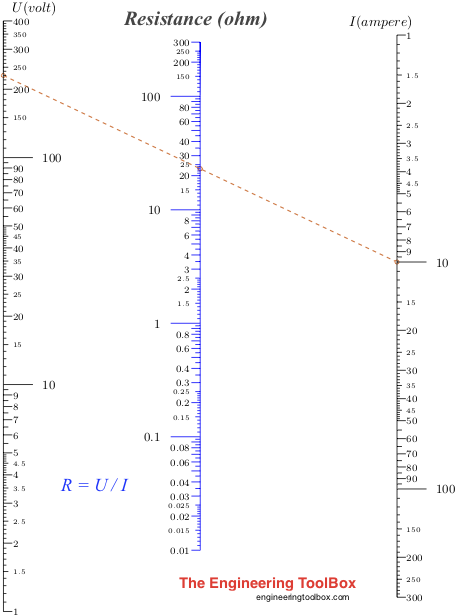
The original resistance and power nomogram images are represented below as interactive Ohm's Law datasets.
电阻 vs 电流 and 电压
功率 vs 电流 and 电压
Equivalent Expressions
Ohm's law can be rearranged to solve for any one variable when the other two are known:
Similarly, the three forms of the power equation allow you to calculate power from whichever pair of quantities you have:
Practical Examples
Example 1 — Simple Circuit
A 12 V battery supplies power to an 18 Ω resistor:
Power dissipated: .
Example 2 — Finding Resistance
A 1 A current flows through a 230 V circuit:
Example 3 — Using SI Prefixes
A 3.3 kΩ resistor must carry 20 mA. The required voltage is:
Example 4 — Appliance Analysis
A 100 W light bulb on a 230 V supply draws:
Practical Examples Summary
电压 (V) | 电流 (A) | 电阻 (Ω) | 功率 (W) | |
|---|---|---|---|---|
| Battery + resistor | 12 | 0.667 | 18 | 8 |
| Household circuit | 230 | 1 | 230 | 230 |
| Precision resistor | 66 | 0.02 | 3300 | 1.32 |
| 100 W light bulb | 230 | 0.435 | 529 | 100 |
来源: engineeringtoolbox.com
还原的原始源表
以下表格还原自原始来源页面,以保留完整的参考数据。
Ohm's Law Source Formula Relationships
The source formula images and calculator relationships are preserved here as a searchable table so the non-image content is retained.
公式 | |||
|---|---|---|---|
| 电压 | V | V = I R | current and resistance |
| 电流 | I | I = V / R | voltage and resistance |
| 电阻 | R | R = V / I | voltage and current |
| 功率 | P | P = V I | voltage and current |
| 功率 | P | P = I^2 R | current and resistance |
| 功率 | P | P = V^2 / R | voltage and resistance |
来源: engineeringtoolbox.com
原始源图
以下原始来源图像予以保留,以免丢失视觉参考资料。当图像包含图表或表格数据时,其提取值已呈现在页面的表格、计算器或交互式图表中;其余图像保留为视觉来源参考。
 ohms law


工程要点
- Temperature dependence: Resistance of metallic conductors increases with temperature. Ohm's law assumes constant temperature; at high currents the resulting temperature rise changes resistance and can violate the linear assumption.
- AC circuits: The basic DC form extends to AC using impedance in place of : . Reactive components (capacitors, inductors) introduce phase shifts between voltage and current.
- Power ratings: Resistors are rated for maximum power dissipation. Exceeding this causes overheating and failure. Always verify that calculated power is below the component rating with appropriate safety margin.
- Measurement safety: When measuring current with a multimeter, break the circuit and place the ammeter in series. Never connect an ammeter across a voltage source — its near-zero internal resistance will draw destructive current.
- Prefix arithmetic: Work in base SI units (V, A, Ω, W) during calculation and convert prefixes at input/output. Mixing prefixes without conversion is a common source of error.