
电阻器色环代码、阻值与公差
根据电阻器色环确定阻值、倍率和公差。
概述
Engineering ToolBox — 工程技术应用的设计与工程资源、工具和基础信息!
The resistor color code is an international standard for marking the resistance value and tolerance of axial-lead through-hole resistors. Each colored band on the resistor body encodes a digit, multiplier, or tolerance specification. This system enables quick identification without requiring measurement instruments.
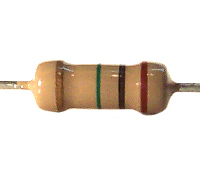
电阻使用四带(标准容差)或五带(精密容差)。 The first band is always located nearest one end of the resistor body.
下载并打印电阻 — 标准色码表。
关键公式
Four-Band Resistance Value
其中 和 为前两个有效数字, 为乘数指数。
Five-Band Resistance Value
其中 、 和 为前三个有效数字, 为乘数指数。
Actual Resistance Range
变量
| 符号 | 说明 | 单位 |
|---|---|---|
| Nominal resistance | Ω | |
| Significant digit from color band | — | |
| Multiplier exponent from color band | — | |
| Actual resistance within tolerance | Ω |
Color Code Reference
公差 | |||
|---|---|---|---|
| Black | 0 | ×1 | — |
| Brown | 1 | ×10 | ±1% |
| Red | 2 | ×100 | ±2% |
| Orange | 3 | ×1 k | — |
| Yellow | 4 | ×10 k | — |
| Green | 5 | ×100 k | ±0.5% |
| Blue | 6 | ×1 M | ±0.25% |
| Violet | 7 | ×10 M | ±0.1% |
| Grey | 8 | ×100 M | — |
| White | 9 | ×1 G | — |
| Gold | — | ×0.1 | ±5% |
| Silver | — | ×0.01 | ±10% |
| None | — | — | ±20% |
来源: engineeringtoolbox.com
Interactive Standard Color Code Chart
The original resistors_standard_color_codes.png image is represented below as numeric color-code data. The multiplier value is shown as a base-10 exponent so gold and silver can be included with the standard digit colors.
电阻器s - 标准 Color Codes
How to Read Resistor Bands
Four-Band Resistors
- Band 1 — First significant digit.
- Band 2 — Second significant digit.
- Band 3 — Multiplier (power of ten).
- Band 4 — Tolerance (gold = ±5%, silver = ±10%, none = ±20%).
Example: Yellow, Violet, Orange, Red → with ±2% tolerance.
Five-Band Resistors
- Band 1 — First significant digit.
- Band 2 — Second significant digit.
- Band 3 — Third significant digit.
- Band 4 — Multiplier.
- Band 5 — Tolerance (brown = ±1%, red = ±2%).
Example: Red, Yellow, White, Orange, Brown → with ±1% tolerance.
计算器
Four-Band 电阻 计算器
Five-Band 电阻 计算器
单位换算器
Electrical 电阻 单位 转换器
还原的原始源表
以下表格还原自原始来源页面,以保留完整的参考数据。
Resistors - Color Codes
公差 | |||
|---|---|---|---|
| Silver | — | 10^-2 | +/- 10% |
| Gold | — | 10^-1 | +/- 5% |
| Black | 0 | 1 | — |
| Brown | 1 | 10 | +/- 1% |
| Red | 2 | 10^2 | +/- 2% |
| Orange | 3 | 10^3 | — |
| Yellow | 4 | 10^4 | — |
| Green | 5 | 10^5 | +/- 0.5% |
| Blue | 6 | 10^6 | +/- 0.25% |
| Violet | 7 | 10^7 | +/- 0.1% |
| Grey | 8 | 10^8 | — |
| White | 9 | 10^9 | — |
| None | — | — | +/- 20% |
来源: engineeringtoolbox.com
Download and print Resistors - Standard Colors Codes table.
Four Band Resistor Calculator
| Band 1 options: None, Brown, Red, Orange, Yellow, Green, Blue, Violet, Gray, White | Band 2 options: None, Black, Brown, Red, Orange, Yellow, Green, Blue, Violet, Gray, White | Multiplier options: None, Black, Brown, Red, Orange, Yellow, Green, Blue, Gold, Silver | Tolerance options: None, Brown, Red, Gold, Silver |
| 47 kOhm +/- 2% | 47 kOhm +/- 2% | 47 kOhm +/- 2% | 47 kOhm +/- 2% |
来源: engineeringtoolbox.com
Five Band Resistor Calculator
| Band 1 options: None, Brown, Red, Orange, Yellow, Green, Blue, Violet, Gray, White | Band 2 options: None, Black, Brown, Red, Orange, Yellow, Green, Blue, Violet, Gray, White | Band 3 options: None, Black, Brown, Red, Orange, Yellow, Green, Blue, Violet, Gray, White | Multiplier options: None, Black, Brown, Red, Orange, Yellow, Green, Blue, Gold, Silver | Tolerance options: None, Brown, Red, Gold, Silver |
| 249 kOhm +/- 1% | 249 kOhm +/- 1% | 249 kOhm +/- 1% | 249 kOhm +/- 1% | 249 kOhm +/- 1% |
来源: engineeringtoolbox.com
原始源图
以下原始来源图像予以保留,以免丢失视觉参考资料。当图像包含图表或表格数据时,其提取值已呈现在页面的表格、计算器或交互式图表中;其余图像保留为视觉来源参考。

工程要点
- Reading direction: If the resistor has a gold or silver band, that band is always the tolerance band and should be read from the opposite end. When no metallic band is present, read from the end closest to the first band.
- Temperature coefficient: A sixth band (rare) indicates the temperature coefficient in ppm/°C, typically using the same color-to-digit mapping.
- Surface-mount devices (SMD): Modern chip resistors use a printed numerical code (e.g., "473" = 47 × 10³ = 47 kΩ) or the EIA-96 marking system rather than color bands.
- Standard values: Resistors follow the E-series (E12, E24, E48, E96, E192) preferred-value grids. Not every arbitrary resistance is manufactured; available values follow logarithmic spacing within each decade.
- Tolerance stacking: When combining resistors in series or parallel, the resulting tolerance is generally tighter than individual tolerances due to statistical averaging, but worst-case analysis should use simple addition of absolute deviations.