
电气工程公式
电压、电流、电阻、功率和电能计算的常用电气公式。
概述
直流、单相和三相交流电路的基本公式,涵盖欧姆定律、功率、阻抗和电机计算。
关键公式
欧姆定律
任何电路中电压、电流和电阻之间的关系。
直流功率
能量
其中 t 为时间,以秒 (J) 或小时 (Wh) 为单位。
交流单相功率
交流三相功率
阻抗(串联 RLC)
感抗
容抗
变量
单位 | ||
|---|---|---|
| V | 电压(电位差) | V |
| I | 电流 | A |
| R | 电阻 | Ω |
| P | 有功功率 | W |
| W | 能量 | J or Wh |
| Z | 阻抗 | Ω |
| f | 频率 | Hz |
| L | 电感 | H |
| C | 电容 | F |
| cos φ | 功率因数 | — |
来源: engineeringtoolbox.com
Electrical Units
单位 | ||
|---|---|---|
| 伏特 | V | 推动 1 A 通过 1 Ω 电阻所需的电位 |
| 欧姆 | Ω | 由 1 V 驱动时将电流限制为 1 A 的电阻 |
| 安培 | A | 由 1 V 驱动通过 1 Ω 的电流 |
| 瓦特 | W | 1 A 与 1 V 的乘积;有功功率单位 |
| 伏安 | VA | V 与 A 读数的乘积;在直流中等于瓦特;在交流中由于无功分量可能超过瓦特 |
| 千伏安 | kVA | 1 000 伏安 |
| 功率因数 | PF | 有功功率 (W) 与视在功率 (VA) 之比 |
来源: engineeringtoolbox.com
计算器
欧姆定律
直流功率与能量
功率与能量
单位换算器
The source page included a Unit Converter section. This calculator preserves common electrical unit conversions used with the formulas above.
Electrical 单位 转换器
Motor Formulas
For three-phase AC motors the following relationships apply.
Motor Efficiency
where P_hp is shaft horsepower and P_in is electrical input in watts.
For a three-phase supply:
Motor Current (3-Phase)
Motor Input Power (3-Phase)
Worked Examples
Battery & resistor — A 12 V battery drives an 18 Ω load:
Resistor dissipation — 12 V across 50 Ω for 60 s:
Stove — 5 MJ consumed from 230 V in 60 min:
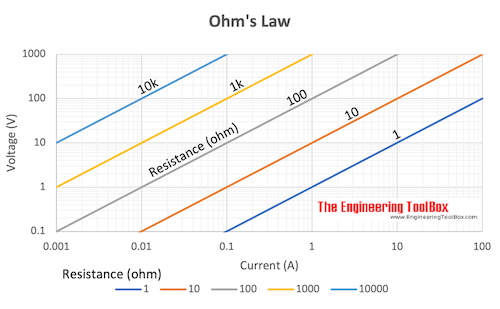
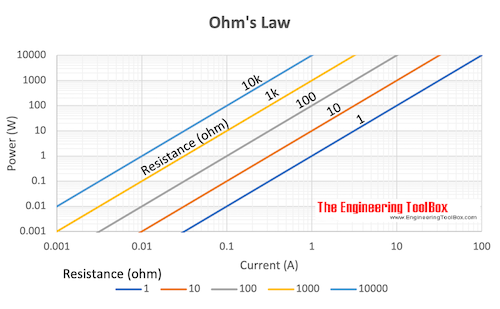
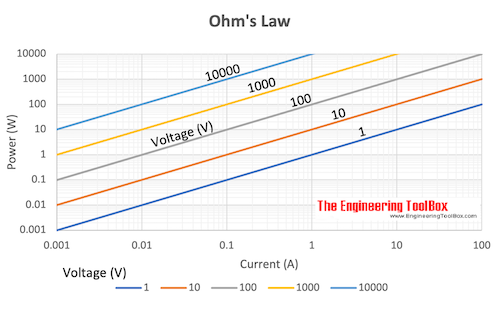
Interactive Ohm's Law Charts
The source page includes Ohm's Law and power nomogram images. The charts below convert their relationships into interactive datasets.
Ohm's Law - 电压 vs 电流 and 电阻
Ohm's Law - 功率 vs 电流 and 电阻
Ohm's Law - 功率 vs 电流 and 电压
还原的原始源表
以下表格还原自原始来源页面,以保留完整的参考数据。
原始源图
以下原始来源图像予以保留,以免丢失视觉参考资料。当图像包含图表或表格数据时,其提取值已呈现在页面的表格、计算器或交互式图表中;其余图像保留为视觉来源参考。
 ohms law
工程要点
- DC vs. AC power: In DC circuits volt-amperes equal watts. In AC circuits the power factor causes apparent power (VA) to exceed real power (W). Always specify whether a rating is in W or VA.
- Power factor correction: Industrial facilities often install capacitor banks to bring the power factor closer to unity, reducing demand charges and line losses.
- Three-phase convention: The √3 factor assumes a balanced three-phase system. Unbalanced loads require per-phase analysis.
- Motor efficiency (η): The constant 746 converts horsepower to watts (1 hp = 746 W). Typical motor efficiencies range from 80 % to 96 % depending on size and class.
- Thermal limits: Formulas assume steady-state conditions. Actual conductor and component ratings must account for ambient temperature, insulation class, and duty cycle per NEC / IEC standards.
- Reactive power: Inductive and capacitive reactance cause current and voltage to be out of phase. The impedance formula combines resistive and reactive components in series.