
Temperature Scales and Conversion
Celsius, Fahrenheit, Kelvin and Rankine temperature scales with conversion formulas.
Overview
Temperature is a fundamental measurement in engineering, describing the thermal state of a substance. The three most common scales are Celsius (°C), Fahrenheit (°F), and Kelvin (K). Understanding and converting between them is essential for international collaboration, material science, thermodynamics, and process control.
Key Formulas
The following formulas are used to convert between the Celsius, Fahrenheit, and Kelvin temperature scales.
Celsius to Fahrenheit
Fahrenheit to Celsius
Celsius to Kelvin
Kelvin to Celsius
Variables
| Symbol | Description | Unit |
|---|---|---|
| Temperature in degrees Celsius | °C | |
| Temperature in degrees Fahrenheit | °F | |
| Temperature in Kelvin | K |
Common Reference Points
Reference Point | Celsius (°C) | Fahrenheit (°F) | Kelvin (K) |
|---|---|---|---|
| Absolute Zero | -273.15 | -459.67 | 0 |
| Freezing Point of Water (at 1 atm) | 0 | 32 | 273.15 |
| Triple Point of Water | 0.01 | 32.018 | 273.16 |
| Average Human Body Temperature | 37 | 98.6 | 310.15 |
| Boiling Point of Water (at 1 atm) | 100 | 212 | 373.15 |
Source: engineeringtoolbox.com
Temperature Converter
Celsius Temperature Converter
Fahrenheit, Kelvin and Rankine Converter
Temperature Difference Converter
Celsius vs Fahrenheit Interactive Chart
Celsius vs Fahrenheit
Temperature Converter Web App
The source page notes that the Temperature Converter Web App can be added to a mobile device or desktop. The app is saved in the browser and works offline automatically after the first visit. The source also includes a "Make Shortcut to this Calculator on Your Home Screen" prompt; the interactive converters above preserve the same on-page conversion functionality.
Restored Original Source Tables
The following tables are restored from the original source page to preserve the complete reference data.
Temperature Units
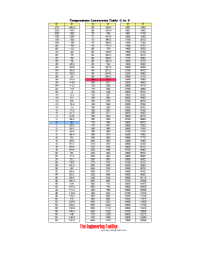
°R | K | °F | C |
|---|---|---|---|
| 0 | 0 | -459.67 | -273.15 |
| 100 | 55.56 | -359.67 | -217.59 |
| 180 | 100 | -279.67 | -173.15 |
| 459.67 | 255.37 | 0 | -17.78 |
| 491.67 | 273.15 | 32 | 0 |
| 559.67 | 310.93 | 100 | 37.78 |
| 671.67 | 373.15 | 212 | 100 |
Source: engineeringtoolbox.com
Celsius vs. Fahrenheit
oC | oF |
|---|---|
| -20 | -4 |
| -15 | 5 |
| -10 | 14 |
| -5 | 23 |
| 0 | 32 |
| 5 | 41 |
| 10 | 50 |
| 15 | 59 |
| 20 | 68 |
| 25 | 77 |
| 30 | 86 |
| 35 | 95 |
| 40 | 104 |
| 45 | 113 |
| 50 | 122 |
Source: engineeringtoolbox.com
Original Source Images
The following original source images are preserved to avoid losing visual reference material. When an image contains chart or tabular data, its extracted values are represented in the page tables, calculators, or interactive charts; remaining images are retained as visual source references.


Engineering Notes
- Absolute Scales: The Kelvin (K) and Rankine (°R) scales are absolute thermodynamic temperature scales. Zero Kelvin is absolute zero, the theoretical point at which all molecular motion ceases.
- Degree Size: A change of 1°C is equal to a change of 1 K. A change of 1°C or 1 K is equal to a change of 1.8°F.
- Practical Usage: Celsius is the standard for most scientific and international engineering work. Fahrenheit remains in common use for everyday weather and some industrial applications in the United States. Kelvin is used in all scientific and engineering thermodynamic calculations.
- Precision: The conversion offset (32) and ratio (5/9 or 9/5) are exact. The triple point of water is a more precise fixed point than the freezing point for calibrating temperature scales.