
Temperature
Reference data and engineering information about temperature for thermodynamics applications.
Overview
Temperature measures the average kinetic energy of particles in a system and determines the direction of heat flow — heat always moves from a warmer body to a cooler one until equilibrium is reached.
Four temperature scales are used across engineering:
- Celsius (°C) — Metric scale; water freezes at 0 °C and boils at 100 °C at standard pressure.
- Fahrenheit (°F) — US customary scale; water freezes at 32 °F and boils at 212 °F.
- Kelvin (K) — Absolute metric scale; zero Kelvin equals absolute zero (−273.15 °C). No degree symbol is used.
- Rankine (°R) — Absolute imperial scale; zero Rankine equals absolute zero (−459.67 °F).
Absolute zero, the theoretical lower limit of temperature, is 0 K (−273.15 °C, −459.67 °F, 0 °R). All molecular motion ceases at this point.
Key Formulas
Celsius ↔ Fahrenheit
Celsius ↔ Kelvin
Rankine ↔ Other Scales
Temperature Difference
Temperature differences convert with a scale factor only — no offset:
Example: Water cooled from 100 °C to 60 °C. The difference is ΔT = 40 °C = 72 °F (not 140 °F − 104 °F without the offset). In Fahrenheit: ΔT = 1.8 × 40 = 72 °F.
Variables
| Symbol | Description | Unit |
|---|---|---|
| Temperature | K, °C, °F, °R | |
| Temperature difference | K, C°, °F, °R |
Four-Scale Conversion Table
Kelvin (K) | Celsius (°C) | Fahrenheit (°F) | Rankine (°R) |
|---|---|---|---|
| 0 | -273.15 | -459.67 | 0 |
| 55.56 | -217.59 | -359.67 | 100 |
| 100 | -173.15 | -279.67 | 180 |
| 255.37 | -17.78 | 0 | 459.67 |
| 273.15 | 0 | 32 | 491.67 |
| 310.93 | 37.78 | 100 | 559.67 |
| 373.15 | 100 | 212 | 671.67 |
Source: engineeringtoolbox.com
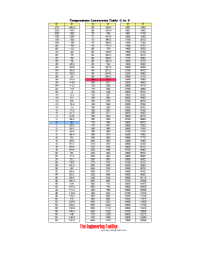
Celsius ↔ Fahrenheit Reference
Celsius (°C) | Fahrenheit (°F) |
|---|---|
| -20 | -4 |
| -15 | 5 |
| -10 | 14 |
| -5 | 23 |
| 0 | 32 |
| 5 | 41 |
| 10 | 50 |
| 15 | 59 |
| 20 | 68 |
| 25 | 77 |
| 30 | 86 |
| 35 | 95 |
| 40 | 104 |
| 45 | 113 |
| 50 | 122 |
Source: engineeringtoolbox.com
Celsius vs. Fahrenheit
Celsius ↔ Fahrenheit Converter
Celsius ↔ Fahrenheit Converter
Fahrenheit ↔ Celsius Converter
Four-Scale Temperature Converter
The original source converter is restored here with Celsius, Fahrenheit, Kelvin, and Rankine outputs in one calculator.
Temperature Converter - Celsius, Fahrenheit, Kelvin and Rankine
Temperature Difference Converter
Related Mobile App from The Engineering ToolBox
The original page promoted adding the temperature converter web app to mobile devices. That content is preserved as the migrated web-app note: the temperature converter can be used as a browser-based calculator on phones and tablets for quick Celsius, Fahrenheit, Kelvin, and Rankine conversions without installing a separate native application.
Restored Original Source Tables
The following tables are restored from the original source page to preserve the complete reference data.
Temperature Units
°R | K | °F | C |
|---|---|---|---|
| 0 | 0 | -459.67 | -273.15 |
| 100 | 55.56 | -359.67 | -217.59 |
| 180 | 100 | -279.67 | -173.15 |
| 459.67 | 255.37 | 0 | -17.78 |
| 491.67 | 273.15 | 32 | 0 |
| 559.67 | 310.93 | 100 | 37.78 |
| 671.67 | 373.15 | 212 | 100 |
Source: engineeringtoolbox.com
Celsius vs. Fahrenheit
oC | oF |
|---|---|
| -20 | -4 |
| -15 | 5 |
| -10 | 14 |
| -5 | 23 |
| 0 | 32 |
| 5 | 41 |
| 10 | 50 |
| 15 | 59 |
| 20 | 68 |
| 25 | 77 |
| 30 | 86 |
| 35 | 95 |
| 40 | 104 |
| 45 | 113 |
| 50 | 122 |
Source: engineeringtoolbox.com
Original Source Images
The following original source images are preserved to avoid losing visual reference material. When an image contains chart or tabular data, its extracted values are represented in the page tables, calculators, or interactive charts; remaining images are retained as visual source references.


Engineering Notes
- Notation convention: Use °C for an absolute temperature reading and C° for a temperature difference. For example, a rise from 20 °C to 50 °C is a 30 C° change. The same change equals 54 °F or 54 °R difference.
- Scale increments: 1 K = 1 C° = 1.8 °F = 1.8 °R. The Celsius and Kelvin scales share the same degree size; Fahrenheit and Rankine share the same (smaller) degree size.
- Rankine usage: The Rankine scale appears mainly in legacy US aerospace and power-cycle thermodynamic calculations. Modern international work uses Kelvin.
- Practical limits: While absolute zero is the theoretical floor, the cosmic microwave background sets a natural ambient temperature of about 2.7 K. Most engineering materials change properties significantly below −40 °C, where the Celsius and Fahrenheit scales happen to intersect (−40 °C = −40 °F).
- Precision: When converting between scales, carry extra decimal places through intermediate steps to avoid rounding errors in derived calculations such as heat transfer or efficiency.