
Ohms Law
Reference data and engineering information about ohms law for electrical applications.
Overview
Ohm's law describes the fundamental relationship between voltage, current, and resistance in an electrical circuit: the current through a conductor is directly proportional to the voltage across it and inversely proportional to the resistance.
This principle applies to linear (ohmic) conductors — most metals at constant temperature. Non-ohmic devices such as diodes and thermistors do not obey Ohm's law.
Key Formulas
Ohm's Law
Power Dissipation
Energy
Variables
| Symbol | Description | Unit |
|---|---|---|
| (or ) | Voltage (potential difference) | V |
| Current | A | |
| Resistance | Ω | |
| Power | W | |
| Energy | J | |
| Time | s |
Common SI Prefixes in Electrical Work
Currents, voltages, and resistances in practical circuits often span many orders of magnitude. The most frequently used prefixes are listed below.
Prefix | Symbol | Factor |
|---|---|---|
| mega | M | × 10⁶ |
| kilo | k | × 10³ |
| milli | m | × 10⁻³ |
| micro | μ | × 10⁻⁶ |
Source: engineeringtoolbox.com
Ohm's Law Calculator
Ohm's Law
Power Calculator
Electrical Power
Unit Converter
Ohm's Law Unit Converter
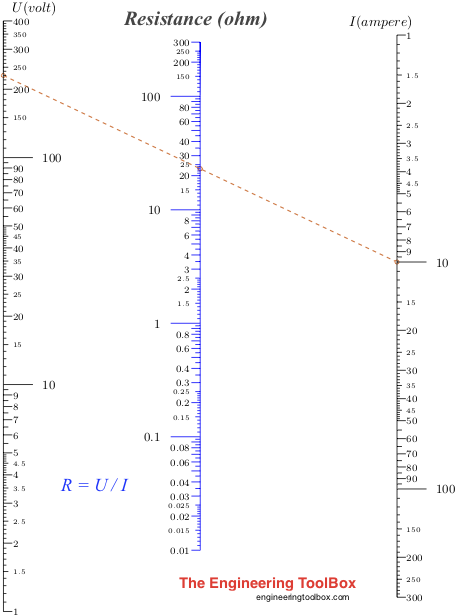
Interactive Nomograms
The original resistance and power nomogram images are represented below as interactive Ohm's Law datasets.
Resistance vs Current and Voltage
Power vs Current and Voltage
Equivalent Expressions
Ohm's law can be rearranged to solve for any one variable when the other two are known:
Similarly, the three forms of the power equation allow you to calculate power from whichever pair of quantities you have:
Practical Examples
Example 1 — Simple Circuit
A 12 V battery supplies power to an 18 Ω resistor:
Power dissipated: .
Example 2 — Finding Resistance
A 1 A current flows through a 230 V circuit:
Example 3 — Using SI Prefixes
A 3.3 kΩ resistor must carry 20 mA. The required voltage is:
Example 4 — Appliance Analysis
A 100 W light bulb on a 230 V supply draws:
Practical Examples Summary
Scenario | Voltage (V) | Current (A) | Resistance (Ω) | Power (W) |
|---|---|---|---|---|
| Battery + resistor | 12 | 0.667 | 18 | 8 |
| Household circuit | 230 | 1 | 230 | 230 |
| Precision resistor | 66 | 0.02 | 3300 | 1.32 |
| 100 W light bulb | 230 | 0.435 | 529 | 100 |
Source: engineeringtoolbox.com
Restored Original Source Tables
The following tables are restored from the original source page to preserve the complete reference data.
Ohm's Law Source Formula Relationships
The source formula images and calculator relationships are preserved here as a searchable table so the non-image content is retained.
Quantity | Symbol | Formula | Known values |
|---|---|---|---|
| Voltage | V | V = I R | current and resistance |
| Current | I | I = V / R | voltage and resistance |
| Resistance | R | R = V / I | voltage and current |
| Power | P | P = V I | voltage and current |
| Power | P | P = I^2 R | current and resistance |
| Power | P | P = V^2 / R | voltage and resistance |
Source: engineeringtoolbox.com
Original Source Images
The following original source images are preserved to avoid losing visual reference material. When an image contains chart or tabular data, its extracted values are represented in the page tables, calculators, or interactive charts; remaining images are retained as visual source references.
 ohms law


Engineering Notes
- Temperature dependence: Resistance of metallic conductors increases with temperature. Ohm's law assumes constant temperature; at high currents the resulting temperature rise changes resistance and can violate the linear assumption.
- AC circuits: The basic DC form extends to AC using impedance in place of : . Reactive components (capacitors, inductors) introduce phase shifts between voltage and current.
- Power ratings: Resistors are rated for maximum power dissipation. Exceeding this causes overheating and failure. Always verify that calculated power is below the component rating with appropriate safety margin.
- Measurement safety: When measuring current with a multimeter, break the circuit and place the ammeter in series. Never connect an ammeter across a voltage source — its near-zero internal resistance will draw destructive current.
- Prefix arithmetic: Work in base SI units (V, A, Ω, W) during calculation and convert prefixes at input/output. Mixing prefixes without conversion is a common source of error.