
Mannings Formula Gravity Flow
Reference data and engineering information about mannings formula gravity flow for fluid mechanics applications.
Overview
Manning's formula is the standard empirical equation for calculating cross-sectional average velocity and flow rate in open channels and partially filled conduits. It relates discharge to channel geometry (hydraulic radius), bed slope, and surface roughness through the Manning coefficient. The formula is widely applied in civil and environmental engineering for stormwater, sewer, and irrigation channel design.
Key Formulas
Mean velocity:
Volume flow rate:
Hydraulic radius:
where is the cross-sectional flow area and is the wetted perimeter.
The unit conversion factor is:
| System | |
|---|---|
| SI (metric) | 1.0 |
| Imperial (English) | 1.486 |
Variables
Symbol | Description | Unit |
|---|---|---|
| v | Cross-sectional mean velocity | m/s (ft/s) |
| Q | Volume flow rate | m³/s (ft³/s) |
| n | Manning roughness coefficient | s/m^(1/3) |
| A | Cross-sectional flow area | m² (ft²) |
| R_h | Hydraulic radius | m (ft) |
| S | Channel slope (gradient) | m/m (ft/ft) |
| P_w | Wetted perimeter | m (ft) |
| k_n | Unit conversion factor | 1.0 (SI) / 1.486 (Imperial) |
Source: engineeringtoolbox.com
Manning Roughness Coefficients
Channel Surface | Manning n | Typical Range |
|---|---|---|
| Glass, copper, plastic | 0.01 | 0.009 – 0.011 |
| Smooth concrete, finished plaster | 0.012 | 0.011 – 0.013 |
| Unfinished concrete | 0.014 | 0.012 – 0.016 |
| Concrete pipe (precast) | 0.013 | 0.011 – 0.015 |
| Brickwork | 0.015 | 0.012 – 0.017 |
| Cast iron | 0.013 | 0.011 – 0.015 |
| Corrugated metal | 0.022 | 0.020 – 0.026 |
| Gravel bottom, earth sides | 0.025 | 0.020 – 0.030 |
| Earth channel, clean | 0.022 | 0.018 – 0.025 |
| Earth channel, with stones/weeds | 0.03 | 0.025 – 0.040 |
| Natural stream, clean | 0.03 | 0.025 – 0.035 |
| Natural stream, with vegetation | 0.05 | 0.035 – 0.060 |
Source: engineeringtoolbox.com
Calculator
Manning's Equation — Velocity and Flow Rate
Half-Filled Circular Pipe Calculator
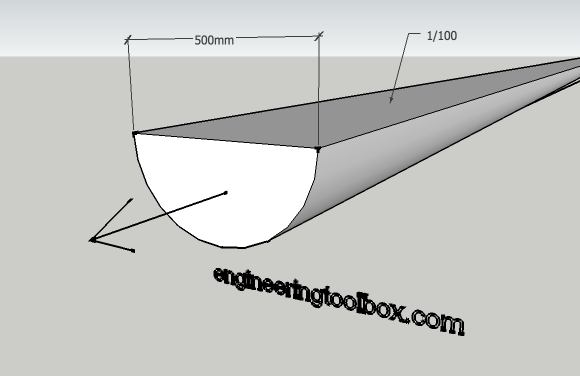
The original source discusses partially filled circular pipes. For a half-filled circular conduit, the flow area is one half of the full circular area and the wetted perimeter is one half of the circumference, so the hydraulic radius is D/4.
Manning Flow - Half-Filled Circular Pipe
Unit Converter
Open Channel Flow Unit Converter
Worked Example: Half-Circle Channel
A concrete half-circle channel (100 % filled) has the following specifications:
- Diameter: 500 mm (0.5 m)
- Material: Concrete,
- Slope: 1/100 m/m
Step 1 — Cross-sectional area:
Step 2 — Wetted perimeter:
Step 3 — Hydraulic radius:
Step 4 — Mean velocity:
Step 5 — Volume flow rate:
Original Source Images
The following original source images are preserved to avoid losing visual reference material. When an image contains chart or tabular data, its extracted values are represented in the page tables, calculators, or interactive charts; remaining images are retained as visual source references.

Interactive Source Diagram Data
The source velocity diagram is represented below with Manning velocity curves for common slopes. The curves use and the same relationship shown in the source diagram:
Gravity Flow Velocity from Manning's Equation
The open-channel diagram basis is also represented as geometry data for a half-circle conduit. At 100% half-circle fill, , , and .
Diameter (m) | Flow area (m²) | Wetted perimeter (m) | Hydraulic radius (m) | Velocity at n=0.012, S=1/100 (m/s) | Flow rate (m³/s) |
|---|---|---|---|---|---|
| 0.2 | 0.0157 | 0.3142 | 0.05 | 1.131 | 0.0178 |
| 0.3 | 0.0353 | 0.4712 | 0.075 | 1.482 | 0.0524 |
| 0.5 | 0.0982 | 0.7854 | 0.125 | 2.083 | 0.2045 |
| 0.8 | 0.2513 | 1.2566 | 0.2 | 2.85 | 0.7163 |
| 1 | 0.3927 | 1.5708 | 0.25 | 3.307 | 1.2985 |
Source: engineeringtoolbox.com/static/docs/documents/800/mannings_formula_channel_flow.png
Engineering Notes
- Manning's equation is empirical and best suited for uniform, steady, turbulent flow in prismatic channels. Avoid applying it to rapidly varied flow or pressurised systems.
- The Manning coefficient is not dimensionless, though it is typically reported without units. Its implied dimensions are s/m^(1/3) in SI.
- values are the same numerically in SI and Imperial systems; only the leading conversion factor changes (1.0 vs. 1.486).
- Typical values range from about 0.010 (smooth, manufactured surfaces) to 0.060 (channels with heavy vegetation and debris).
- For partially filled circular pipes, calculate the wetted area and wetted perimeter as functions of fill depth before applying Manning's equation.
- Accuracy degrades for very shallow flows or slopes steeper than roughly 10 % — consider alternative methods in those regimes.
- Always verify results against local design codes and standards for critical infrastructure.